


3U VPX GPU
3U VPX Product Selection
3U VPX video graphics modules that support the VPX REDI and OpenVPX standards. The 3U VPX boards feature advanced NVIDIA GPUs and Xilinx FPGAs, providing video capture, video output, image and data processing, and video encoding for HEVC and AVC.
High-speed GPUs and FPGAs provide the processing power required for high-performance computing (HPC) and artificial intelligence (AI) tasks.
Support for virtually any video signal, including 12/6/3G-SDI, CoaXPress, ARINC 818-2/3, STANAG-3350 A/B/C, CVBS, RS170, RS343, LVDS, DVI, DisplayPort, Camera/Channel Link, and custom signals. Contact us to discuss your specific requirements.Soporte para prácticamente cualquier señal de video, incluidas 12/6/3G-SDI, CoaXPress, ARINC 818-2/3, STANAG-3350 A/B/C, CVBS, RS170, RS343, LVDS, DVI, DisplayPort, Camera/ Enlace de canal y personalizado. Contáctenos para discutir sus requisitos específicos.
3U VPX Information
The basic VPX standard defined in VITA 46 is a scalable module and backplane technology designed specifically for high-speed, mission-critical embedded systems. 3U VPX modules utilize the 1" pitch allowed in VITA 48 (VPX REDI). We provide system designers with a flexible and highly configurable PCI Express interface that enables a wide range of switch link configurations.
SOLICITA INFORMACIÓN
Our know-how and knowledge of the market, gives us a great proximity to the final customers, who trust DONALBA for the selection of the most appropriate proposals for their projects and programs. Contact us, we will help you to choose the best solution for your business.
3U VPX Modules
3U VPX modules include air-cooled and conduction-cooled options, with other advanced cooling solutions available for MCOTS or custom solutions.
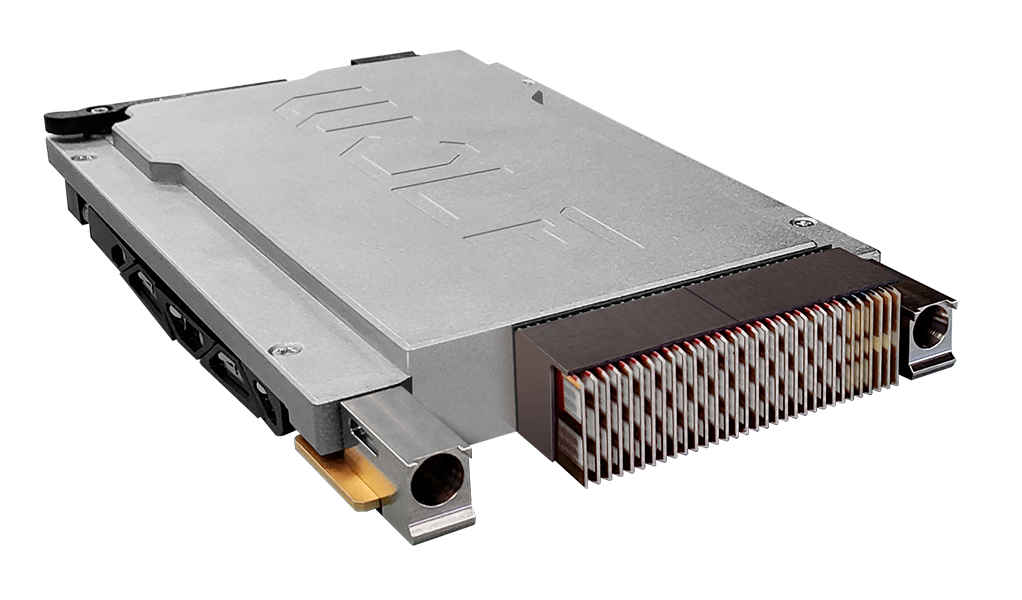
VPX refers to VITA standards such as:
• VITA 46 (VPX Base, 2007): the basic electrical and mechanical specification for VPX
• VITA 48 (VPX REDI, 2010): additional support for high-density electronic modules
• VITA 65 (OpenVPX, 2010): addresses interoperability
• VITA 66 (Optical Interconnect, 2013): defines a family of blind-mate fiber-optic interconnects
• VITA 67 (Blind-Mate Analog Connectors, 2012): defines a family of interconnects and configurations
VITA 46 defines the dimensions of 3U VPX
The VITA 46 working group was first established in 2003. At that time, VMEbus systems (first introduced in 1981) were widely used. VME systems used a parallel VME bus with a maximum bandwidth of 320 Mbytes/second (as defined in VITA 1.5, released in 2003). The newer VPX standard was defined to utilize the latest serial switching architectures, which provided a much higher maximum bandwidth. VPX connectors (board-to-board interconnects) are high-speed MultiGIG RT connectors that support high-speed serial buses. MultiGIG RT 2 supports 10 Gbps, while RT 2-S supports 16 Gbps. The recently developed MultiGIG RT 3 connectors can support up to 32 Gbps, enabling compatibility with PCIe Gen 4 and 100GBase-KR4 Ethernet.
3U VPX cards use 3 connectors (P0 through P2), while 6U VPX cards use 7 connectors (P0 through P6). P0 is reserved for system control and power signals. P1 and P2 are used for high-speed serial bus signals and user I/O. In a 6U VPX, the remaining connectors (P3 through P6) are used for user I/O.
The VPX specification was expanded in VITA 48 (VITA REDI, Reinforced Enhanced Design Implementation) to support the higher operating power of high-density electronic modules by defining mechanical design requirements to accommodate enhanced cooling methods. VPX REDI also establishes standards for the use of ESD shields on both sides of the boards.
OpenVPX (VITA 65) is a system-level VPX specification designed to address interoperability between VPX boards and backplanes from multiple vendors. It was ratified in 2010.
Additional VITA standards have been ratified to support specific types of connectivity and other issues, and their respective VITA committees are still actively working on new VITA standards.